From Mussolini to Trump: Political Interference That Shaped FIFA World Cup History
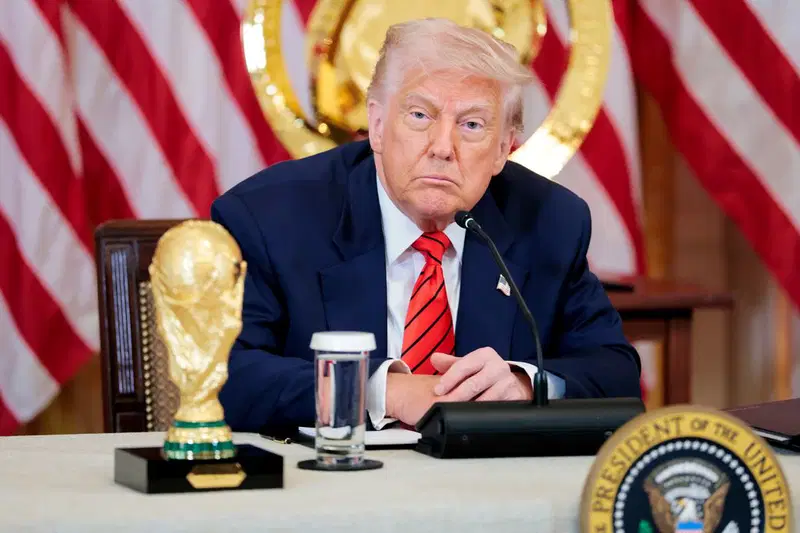
US President Donald Trump’s intervention over Folarin Balogun’s red card has become the latest example of political involvement in FIFA World Cup affairs.
Trump revealed that he personally contacted FIFA President Gianni Infantino to request a review of the dismissal shown to the USA striker. FIFA later suspended Balogun’s one-match ban for a year, allowing him to feature in the United States’ Round of 16 clash against Belgium.
Political influence has surfaced at several World Cups throughout history. Here are some of the most notable examples.
1934 – Mussolini’s World Cup
Italy’s Fascist leader Benito Mussolini used the 1934 FIFA World Cup, hosted by Italy, as a powerful tool to promote both his regime and Italian football.
Mussolini attended every match involving the Italian team and reportedly made unexpected visits to referees before games, fuelling long-standing suspicions over the officiating during the tournament.
Italy eventually lifted the trophy, although controversy surrounded several of their victories.
Former FIFA President Jules Rimet later remarked: “This tournament was organised by Mussolini, not by FIFA.”
1938 – Hitler and Mussolini’s Influence
At the 1938 World Cup in France, Mussolini was joined on the political stage by Nazi dictator Adolf Hitler.
Following Germany’s annexation of Austria earlier that year, several players from Austria’s celebrated “Wunderteam” were forced into the German national team despite many opposing the move.
Germany’s campaign ended in disappointment with a first-round defeat to Switzerland, while Italy retained the title.
Before the final against Hungary, Mussolini reportedly sent his players a chilling message: “Win or die.”
Italy responded with a 4-2 victory.
Hungary goalkeeper Antal Szabo later quipped: “I may have conceded four goals, but I saved their lives.”
1978 – Argentina Under Military Rule
The 1978 World Cup was staged in Argentina during the country’s brutal military dictatorship under Jorge Rafael Videla.
Despite widespread criticism over human rights abuses, FIFA allowed the tournament to proceed.
Argentina’s 6-0 victory over Peru in the second group stage attracted intense scrutiny after the hosts needed to win by at least four goals to reach the final ahead of Brazil.
The result sparked allegations of political influence and secret agreements between the military governments of Argentina and Peru, although no conclusive evidence has ever been established.
Hungary coach Lajos Baroti summed up the mood by saying: “Everything, even the air, is in favour of Argentina.”
Argentina went on to defeat the Netherlands in the final to claim their first World Cup title.
1982 – Kuwait Official Stops Play
One of the most bizarre moments in World Cup history came during the 1982 tournament in Spain.
France appeared to score their fourth goal against Kuwait, but Kuwaiti players stopped after claiming they had heard a whistle from the crowd.
The situation escalated when Sheikh Fahad Al-Ahmed Al-Jaber Al-Sabah, president of the Kuwait Olympic Committee, walked onto the pitch and demanded Soviet referee Myroslav Stupar disallow the goal.
Remarkably, the referee complied and ruled the goal out.
France still went on to win 4-1 after scoring again before full-time, but the incident remains one of the clearest examples of political interference during a World Cup match.